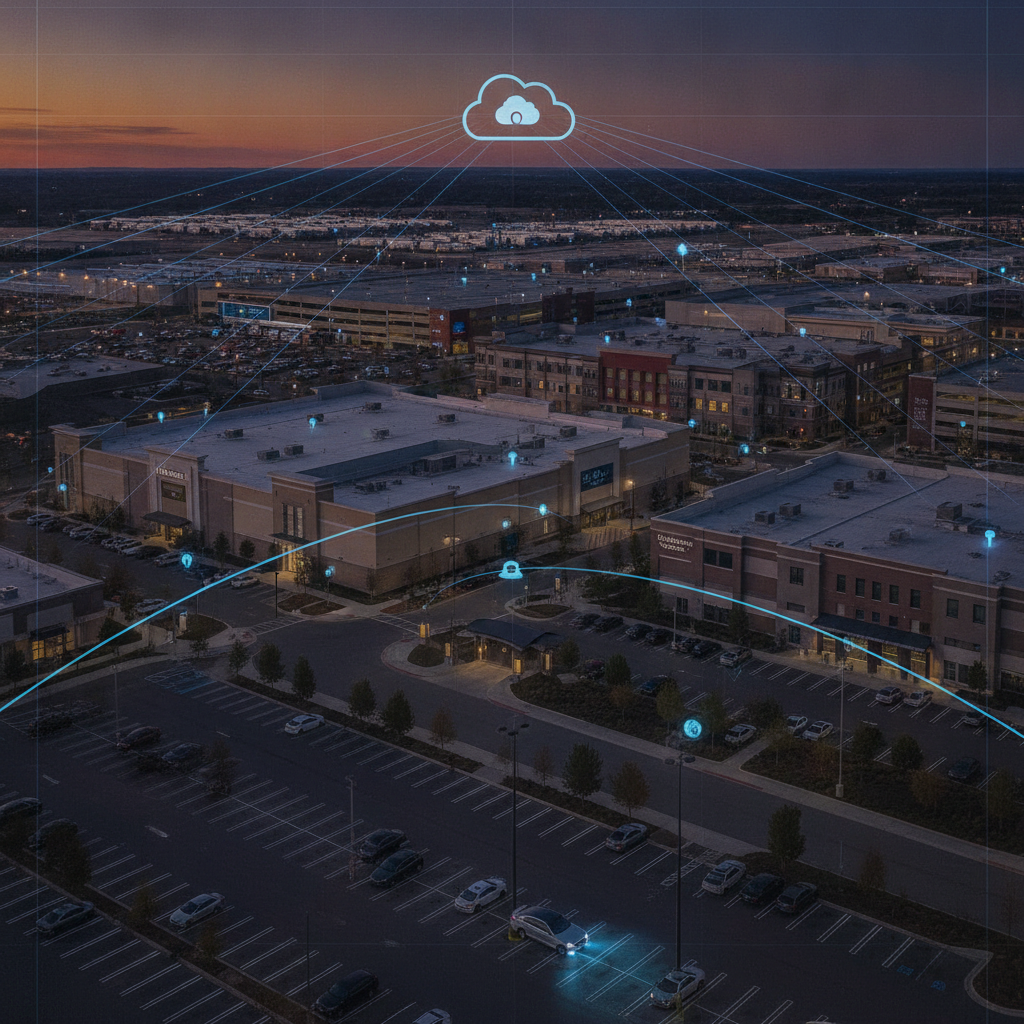
Private license-plate surveillance is no longer a niche police tool mounted on patrol cars. Across retail chains, shopping centers, parking operators, hospitals, universities, apartment complexes, hotels, casinos, logistics hubs and gated communities, automated license-plate readers are quietly turning vehicle movements into searchable records. The result is a sprawling private surveillance layer that can resemble government tracking in function, but not necessarily in oversight.
The core question is simple: what happens when a capability that would trigger intense constitutional, political and public-records scrutiny if deployed by government is instead operated by thousands of private businesses? In that model, the data may begin with a private camera, be stored in a private database and then, in some cases, become available to law enforcement without the agency having built the system itself.
The Scale Hiding In Plain Sight
ALPR technology is no longer confined to police fleets or city-owned camera networks. Major private operators publicly acknowledge deploying license-plate recognition or closely related vehicle-identification systems, including Walmart, Sam’s Club, The Home Depot, Lowe’s, Costco, Macy’s, Kroger/Ralphs, Simon Property Group, South Coast Plaza, Santana Row and Federal Realty. The same pattern extends to parking operators, hospitals, universities, apartment complexes, homeowners associations, hotels, casinos, distribution centers and large mixed-use properties.
That breadth matters because the technology is not simply recording images. An ordinary security camera may capture a parking lot; an ALPR system can convert observations into structured, searchable data tied to specific vehicles. Depending on the system, that may include:
- license-plate number and issuing state
- date, time and camera location
- vehicle image
- make, model, color and body style
- visible characteristics such as roof racks, decals, bumper stickers or damage
- direction of travel
- repeated appearances
- entry and exit times
- historical vehicle-location records that can be queried later
That searchability changes the surveillance equation. A business no longer just has video footage to review after an incident. It may have a database that can answer a very different question: When has this particular vehicle appeared here? That is the point at which a parking-lot camera becomes a tracking system.
Public Policies Show A Narrower Version Of Oversight
For large retailers and property operators, the publicly available ALPR policies that do exist usually address some combination of data collection, retention and law-enforcement access. But the policies vary widely, and the most important governance questions are often difficult for outsiders to verify.
Across corporate deployments, the recurring issues are familiar:
- What is collected? Some systems store only plate reads; others retain images and vehicle attributes.
- Who owns the data? In many cases, the business controls the account, but vendors may host or process the information.
- Who can access it? Access may be limited to security staff, corporate administrators, property managers or approved tenants.
- Is it audited? Some systems can log searches and access events, but public evidence of routine review is often limited.
- How long is it kept? Retention periods may be configurable, but the default is not always transparent.
- Can data be preserved? Some platforms can extend retention for investigations or legal holds.
- Can users create alerts? Many systems can flag a specific plate or vehicle for future appearances.
- Can information be shared? Businesses may share within a corporate group, with tenants or with law enforcement depending on policy and circumstance.
The public disclosures that are available typically do not answer every question a regulator, journalist or consumer would ask. For example, a policy may describe data retention but not say who reviews audit logs, how often reviews occur, whether misuse triggers discipline or whether deletion requests are honored. In other words, the technology may be documented, but governance often remains opaque.
The Oversight Gap Between Public And Private Surveillance
The legal architecture that constrains government surveillance does not map neatly onto private ALPR networks. Public agencies may face constitutional limits, open-records laws, procurement rules, hearings and records-retention requirements. Private businesses generally do not operate under the same transparency regime.
That does not mean private companies are unconstrained. They still face consumer-protection law, contract obligations, state privacy rules, civil liability and reputational risk. But the practical oversight model is very different. A retailer or landlord can deploy ALPR across a portfolio of properties without a public vote, a procurement hearing or a public database of camera locations.
That decentralization is what makes the trend so consequential. America may be developing a distributed private vehicle-surveillance infrastructure that government can sometimes access after the fact, rather than build and operate directly. Law enforcement may seek information by subpoena, warrant, court order or voluntary request depending on the company, the jurisdiction and the circumstances. In some cases, companies may disclose information without compulsory process if their policies permit it. In others, the threshold may be higher. The public often cannot easily tell from the outside.
The Insider-Abuse Problem And The Need For Real Controls
The most overlooked risk may be internal misuse. Any system that allows employees or contractors to search vehicle histories creates the possibility of abuse: stalking, harassment, competitive intelligence gathering, selective enforcement or unauthorized sharing. A single insider with broad access can turn a compliance tool into a tracking tool.
That is why the unresolved questions matter so much. Does the company log every search? Are those logs reviewed? By whom? How often? Are alerts triggered by unusual activity? Can access be restricted by role or location? Are training requirements documented? Are employees disciplined when they misuse the system? Can a consumer ask whether a vehicle appears in the database, or seek deletion or correction?
Those are not minor administrative details. They are the safeguards that determine whether ALPR functions as a limited security tool or a durable surveillance infrastructure.
The debate is no longer about whether ALPR exists. It is about where it lives, who controls it and what accountability follows the data after it is captured. As private networks expand across everyday spaces, the public may be facing a new reality: vehicle surveillance that is everywhere, searchable and often invisible until the moment someone asks who can see the record.
Want this kind of strategy working for your dealership?
Use Trailer Sales Expert to sharpen sales conversations, follow-up, and local content.