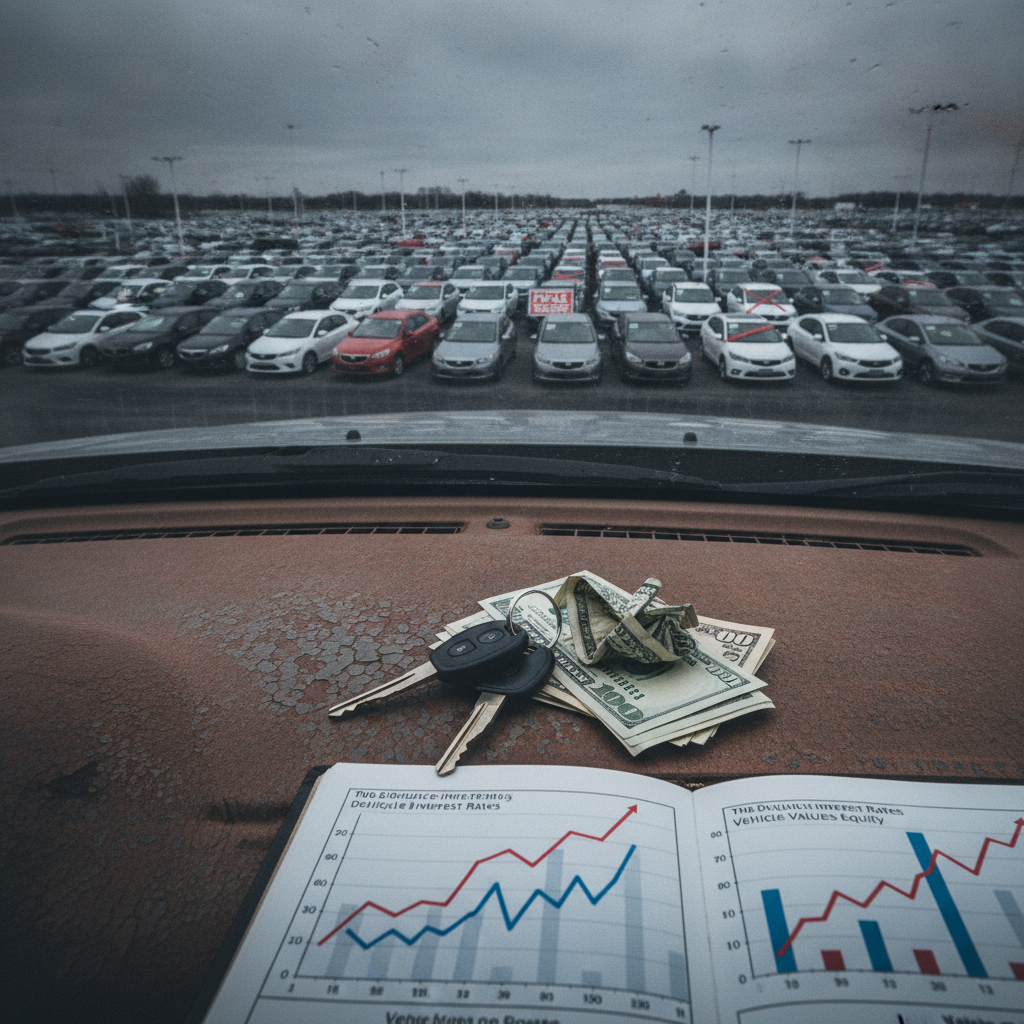
The viral version of the story is easy to state: auto delinquencies are at record highs, dealers are sitting on roughly $200 billion in unsold inventory, and drivers are drowning in negative equity. The reality is more complicated. There is real strain in the U.S. auto market, especially for subprime borrowers and households stretched by high prices and high rates, but the current situation is not a simple replay of the 2008 housing crash.
What The Headlines Get Right — And What They Stretch
Start with delinquency. When people say auto delinquencies are rising, they are usually talking about borrowers who are behind on monthly payments. That is a genuine warning sign, but it matters a great deal who is falling behind. Overall delinquency includes everyone with an auto loan; subprime delinquency focuses on borrowers with weaker credit histories, who are much more vulnerable when payments rise or budgets tighten.
That distinction is crucial. Broad, top-line delinquency numbers can look manageable while the lowest-credit borrowers are already under intense stress. Recent reporting from the Federal Reserve Bank of New York, Experian, TransUnion, Fitch, and other market trackers has consistently shown that the pressure is most severe in the subprime slice of the market, not evenly spread across all auto borrowers.
The same is true for “$200 billion in unsold inventory.” Dealers do not hold a single giant pile of stale vehicles in some warehouse-like market. Inventory is spread across new cars on lots, used vehicles, and regional supply chains. What matters is not the headline dollar figure by itself, but how long vehicles sit, how much discounting is needed to move them, and whether aging inventory is tied up in models consumers no longer want at current prices.
Why Subprime Borrowers Are Feeling The Squeeze
Subprime borrowers are the people most likely to be hit first when monthly payments become too high. They often have smaller savings cushions, lower incomes, and less room to refinance into a better rate later. If a payment is already near the edge of affordability, even a modest increase in insurance, fuel, repairs, or rent can trigger missed payments.
Auto lending has become especially punishing because the price of the vehicle is only one part of the bill. High interest rates raise the cost of borrowing. Vehicle prices remain elevated relative to pre-pandemic norms. Insurance costs have climbed. And depreciation — the value a car loses over time — continues whether the borrower can afford the loan or not.
Here is a plain-English definition: delinquency means a borrower is late on a payment. Repossession means the lender takes the vehicle back after enough missed payments. Subprime lending means loans made to borrowers with weaker credit, usually at higher interest rates because the lender sees more risk.
How Negative Equity Traps Borrowers
Negative equity happens when a borrower owes more on the loan than the car is worth. In other words, the loan balance is “underwater.” This is common in auto finance because cars lose value quickly, especially in the first few years.
Long loan terms make the problem worse. A 72-month or 84-month loan lowers the monthly payment, but it also slows the pace at which the principal is paid down. That means the borrower can spend years still owing more than the vehicle would fetch in a trade-in or resale.
The oft-cited “30% negative equity” figure usually refers to trade-ins, not every auto loan in existence. That difference matters. Many drivers with loans are not underwater to that degree, but a meaningful share of people trying to trade, refinance, or roll over an existing balance into a new loan are.
A Realistic Example
Consider a buyer who purchases a $50,000 vehicle with a small down payment, then finances the rest for 84 months at a high interest rate. The monthly payment may look just manageable at the dealer desk. But after two years, the car has depreciated sharply, while the loan balance has fallen much more slowly.
If the borrower now owes, say, the low-to-mid $40,000s while the vehicle is worth much less on the used market, they are trapped. They can keep making the payment and remain current, but they cannot easily sell or trade out without bringing cash to the table. If the car is wrecked, if life changes force a sale, or if the borrower wants to move into a cheaper vehicle, the negative equity becomes a real financial handcuff.
What Dealer Inventory Actually Means
Dealer inventory is often discussed as if it were proof that the market is collapsing. It is more accurate to view it as a signal of friction. Too much inventory can mean dealers overestimated demand, financing conditions tightened, or buyers simply cannot afford current prices.
Cox Automotive and other industry trackers have shown that inventory has normalized from the extreme shortages of the pandemic era. That is not the same as saying the market is healthy everywhere. Some dealers are still carrying expensive new vehicles that are harder to sell, while consumers are shopping more carefully and waiting for discounts. Inventory levels can also vary sharply by brand, region, and segment.
Why The Whole System Has Not Become A 2008-Style Crisis
This situation is serious, but it is not automatically a housing-crash replay. The auto market is smaller than housing, loans are generally shorter, and the financing structures are different. Auto loans are also easier to repossess and liquidate than homes, which can limit how far losses spread through the system.
That does not mean there is no risk. Repossessions and forced trade-ins can put more used vehicles back on the market, which can pressure used-car prices. Lower used-car values then increase negative equity for other owners, creating a feedback loop. Lenders with concentrated exposure to subprime borrowers, long-duration loans, or high loan-to-value lending are the most exposed. So are dealers that depend on rolling customers from one car into the next, and households that are already stretched thin.
What would turn this into a broader financial crisis? Much more stress than we see now: a sharp rise in unemployment, sustained jumps in defaults and repossessions, falling used-car values, tighter credit across the board, and losses large enough to damage lenders beyond the specialized auto-finance space.
What To Watch Next
Over the next 12 to 24 months, the key indicators are straightforward:
- Delinquency rates, especially among subprime borrowers
- Repossession volumes and whether they keep rising
- Used-car values, particularly for higher-mileage and lower-end vehicles
- Dealer inventory, including how long cars sit before sale
- Loan terms, especially whether 72- and 84-month financing remains common
- Interest rates, which directly affect affordability
- Negative equity, especially at trade-in and rollover points
The central message is simple: the viral version is overstated, but underneath the exaggeration is a legitimate auto-affordability and consumer-debt problem. Many borrowers are not in immediate crisis, but enough are under pressure that the warnings should be taken seriously. The market is not necessarily headed for a 2008-style collapse, but it is clearly revealing how fragile car ownership has become for a large share of American households.
Want this kind of strategy working for your dealership?
Use Trailer Sales Expert to sharpen sales conversations, follow-up, and local content.