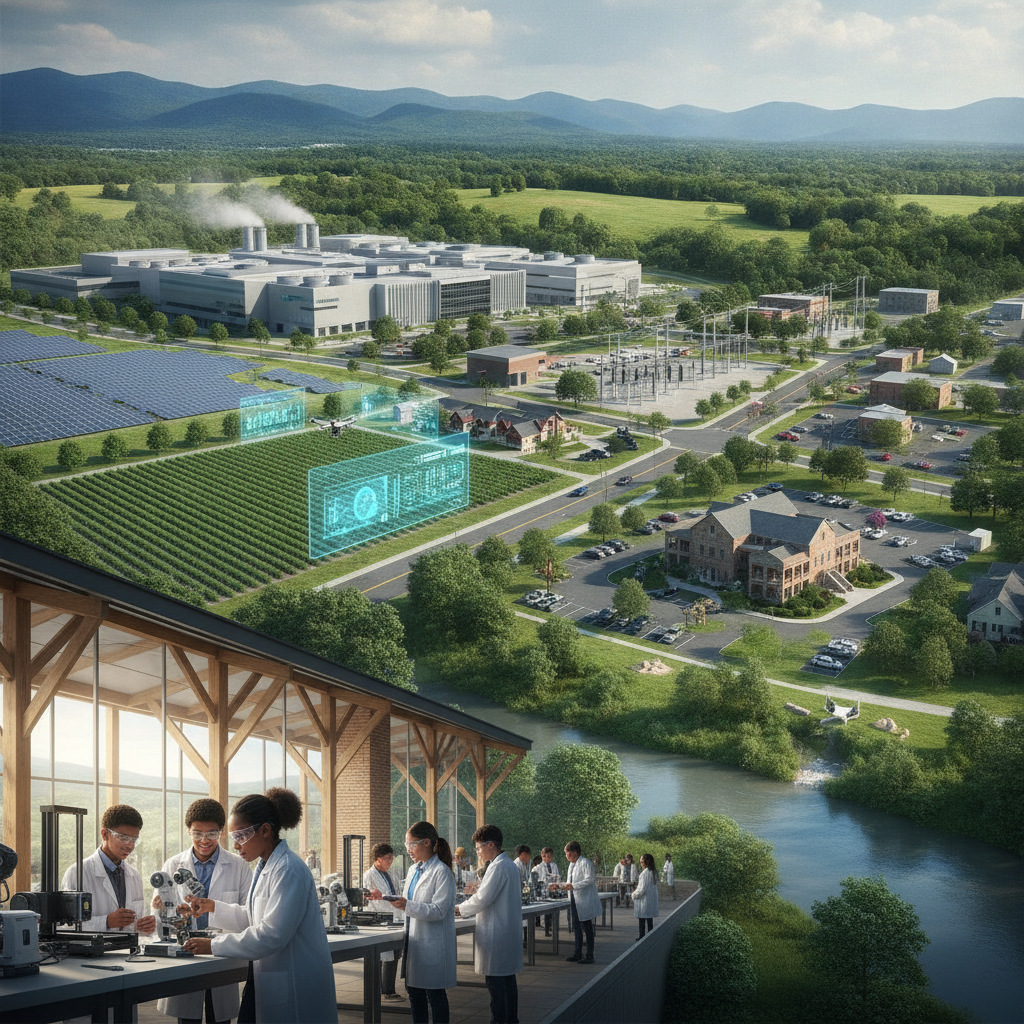
Franklin County, Virginia sits in a conversation that is spreading far beyond its borders. Across America, communities are being asked whether they will welcome data centers. That is the wrong question. The better question is far bigger: how can a community become dramatically better because a data center chooses to locate there?
That shift in perspective matters. Data centers represent one of the largest capital investments in modern history, and companies like Microsoft, Amazon, Google, Meta, Oracle and others are among the wealthiest and most innovative organizations ever created. Communities are right to ask hard questions about secrecy, water usage, noise, transmission lines, taxes and energy demand. Those concerns are real. But almost nobody is asking with equal force what transformational benefits these companies should bring to the places that host them.
The Question Communities Should Be Asking
For too long, local debates have been framed as a simple yes or no. Do we accept the project, or do we reject it? That framing pushes communities into a defensive posture. It leads to negotiations built around fear, not leverage.
A different approach starts with a better premise: communities already hold assets that technology companies need. Land. Power. Water. Local government cooperation. Public trust. Workforce. Those are not just reasons to approve a permit. They are negotiating strengths.
So the real question becomes: what should Franklin County look like in 30 years if one of the world’s richest companies becomes our neighbor?
That question invites ambition. It asks whether a major industrial presence can help create a stronger local economy, better schools, more resilient infrastructure and a higher quality of life for residents who stay long after the first construction crew leaves.
From Community Host to Community Partner
Economic development has often relied on a familiar model. A company arrives. A locality offers incentives. Jobs and tax revenue are promised. The community hopes for the best.
That model is no longer enough when the investment is this large and the company is this powerful. If a community is making room for infrastructure that supports the future of artificial intelligence, cloud computing and digital commerce, then economic development should evolve beyond tax incentives toward measurable community outcomes.
That does not mean ignoring practical constraints. Data centers have legitimate impacts involving energy, water, land use and quality of life. It means treating those impacts as part of a broader public compact. If a project requires new transmission lines, the community should also ask whether it can help modernize the grid. If demand rises, can the company help increase supply instead of competing with residents for existing power?
If a facility uses water or affects land, can it also contribute to water infrastructure improvements, environmental restoration projects or community resilience projects that leave the region stronger than before?
A true partner does not just operate next to a community. It invests in the community’s future.
A Community Benefit Framework
If data centers are going to be part of the next chapter for places like Franklin County, then communities should define success in measurable terms. Not vague promises. Not one-time donations. Long-term commitments that can be tracked, reported and improved over time.
A community benefit framework could include:
- New power generation added alongside new demand, so growth expands overall supply instead of straining local residents.
- Investments that help stabilize or reduce long-term energy costs.
- Modernization of the electric grid.
- Infrastructure improvements that benefit residents and future businesses.
- Workforce development beginning in middle school and continuing through college.
- AI academies, robotics labs and maker spaces that prepare students for future careers.
- Entrepreneurship funds for local innovators.
- Agricultural technology that helps preserve farming while making it more profitable.
- Scholarships tied to engineering, skilled trades and cybersecurity.
- Public-private research partnerships.
- Local innovation districts that attract new companies and talent.
- Broadband expansion.
- Emergency management technology that strengthens public safety.
- Environmental restoration projects.
- Water infrastructure improvements.
- Transparent reporting on goals, spending and results.
These are not unrealistic asks. They are the kind of community-building investments that match the scale of the opportunity. If a company can build infrastructure that powers global AI, it can also help build the systems that improve daily life for the people living nearby.
A good framework also recognizes that some benefits should be permanent. A county should not be left with a one-time check and a long-term set of burdens. It should gain lasting value: skills, facilities, resilience, educational pathways and public assets that outlive the construction cycle.
Building A Future Worth Staying For
The strongest argument for a community benefit framework is not just fairness. It is survival and growth.
Many rural and suburban communities face the same quiet challenge: young people leave because they do not see a future that feels local, modern and meaningful. A data center presence should not accelerate that trend. It should help reverse it.
That is why workforce development matters so much. Middle school students should be able to see a path into engineering, coding, advanced manufacturing, cybersecurity and skilled trades. High school students should have access to internships, certifications and technical training. Community college and university partnerships should create clear ladders into good jobs.
At the same time, technology companies can help preserve what makes communities like Franklin County distinctive. Agricultural modernization can support farmers instead of replacing them. Broadband expansion can help small businesses compete. Emergency management technology can improve response times. Local innovation districts can give residents a place to test ideas, launch businesses and build something new.
This is the larger promise that often goes unspoken. A data center should not only store the future. It should help a community prepare for it.
The Measure of a Good Neighbor
None of this requires attacking companies or elected officials. It requires a better standard.
Communities should not ask only whether a project brings jobs and tax revenue. They should ask whether it expands opportunity. Whether it strengthens public infrastructure. Whether it helps lower risk. Whether it creates a pipeline for local students and workers. Whether it leaves behind durable assets instead of temporary attention.
The companies building data centers are some of the most capable organizations in the world. Their scale is part of why they can shape local outcomes in meaningful ways. That creates responsibility, but it also creates possibility.
Franklin County is not unique in this moment. Communities across America are facing similar decisions. The ones that do best will not be the ones that simply say yes fastest or no loudest. They will be the ones that negotiate from a position of confidence and think in generations instead of headlines.
America does not need communities that simply host AI infrastructure. America needs communities that become more prosperous because AI infrastructure chose them.
That is the deeper debate now. Not whether data centers belong in our communities, but what kind of communities we intend to build around them. If the next generation of American innovation is going to be built here, why shouldn't the next generation of American prosperity be built here too?
Want this kind of strategy working for your dealership?
Use Trailer Sales Expert to sharpen sales conversations, follow-up, and local content.